
At Elite Landscapes LLC, we understand the nuisance and potential damage caused by inefficient drainage systems. Our Drainage Solutions are designed with one goal in mind—preventing water accumulation that can damage your beautiful landscape and potentially harm your property’s foundation.
Why Choose Our Drainage Solutions?
Pooling water, poorly redirected rain runoff, and improper groundwater management can lead to landscape erosion, plant loss, and even structural damage. Our team at Elite Landscapes tackles these issues head-on with an effective and customized approach.
Specialized in Comprehensive Drainage Systems
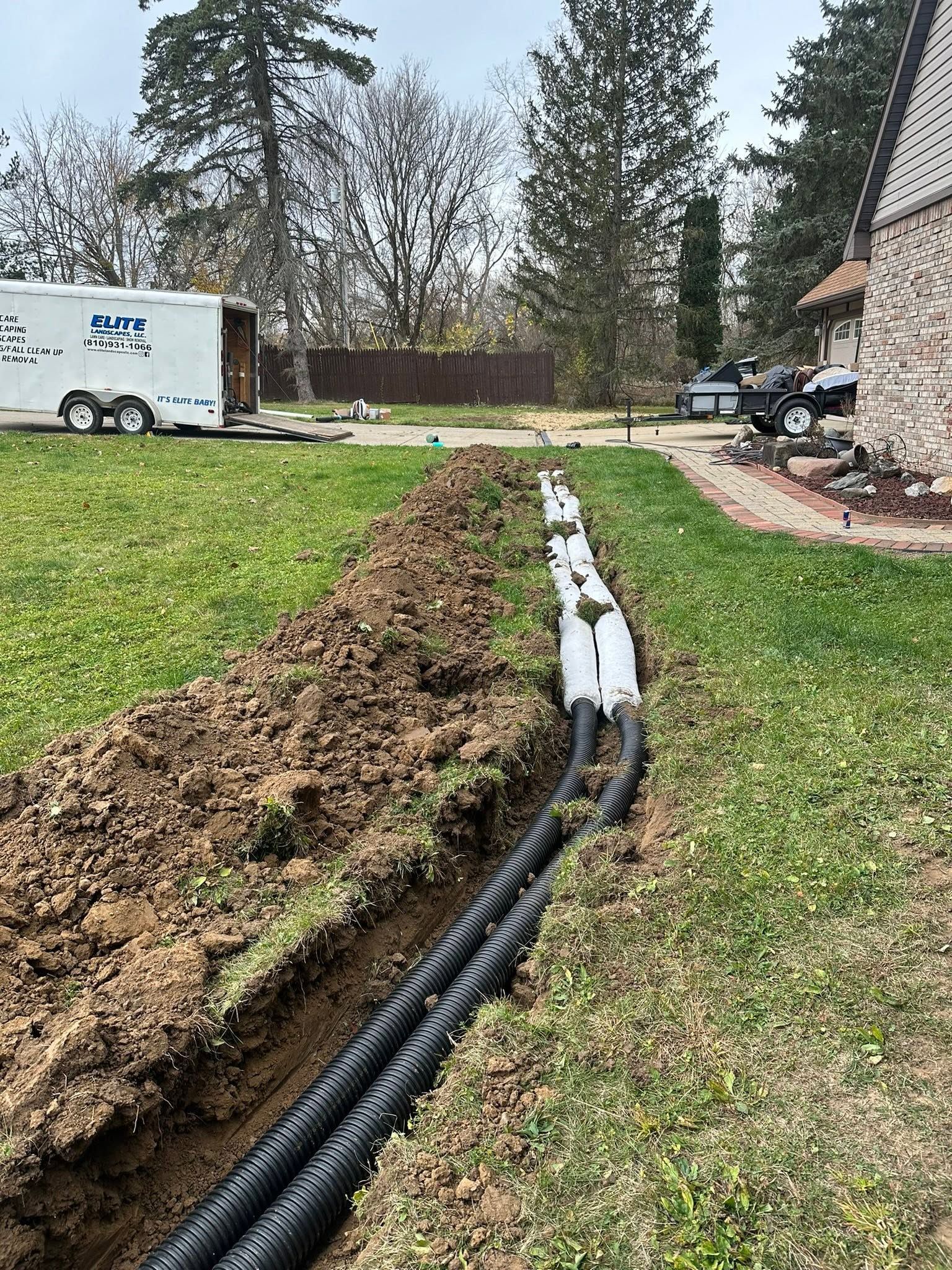
French Drains: These are perfect for redirecting excess water away from key property areas and preventing landscaping erosion.
Gutters and Downspouts: Essential components to manage rainwater effectively and channel it safely away from your property’s foundation.
Channel Drains: Ideal for areas requiring quick and efficient surface water management techniques to avoid pooling.
Our Process
We start with a detailed evaluation of your current drainage issues and landscape conditions. This allows us to create a tailored plan that addresses your unique needs efficiently. Our team employs high-quality materials and precise installation practices to ensure long-lasting solutions.
Expert Team, Proven Results
Founded in 2018, Elite Landscapes has quickly made a mark as a trustworthy service provider in the Greater Lansing area. Our expert team of dedicated professionals, is committed to providing top-tier workmanship. With specialized knowledge in tackling detailed drainage challenges, we ensure not only effectiveness but also minimal disruption to your existing landscape.
We take pride in approaching each project with integrity and attention to detail, resulting in reliable and aesthetically appealing drainage solutions.
Benefits to You
Prevent costly damage and water pooling problems in the future.
Protect your landscape investments and enhance property value.
Work with a friendly, local team who knows the region’s specific weather and drainage challenges best.
Ready to protect your landscape with the right drainage solutions? Give us a call at (810) 931-1066 today and let's get your landscape on track.
What Proper Drainage Requires
Surface grading moves soil to create positive slope away from foundations, low spots, and areas where water collects. The grade needs to drop at least two percent over the first ten feet from the foundation to move water effectively without creating erosion channels. French drains intercept subsurface water by placing perforated pipe in a gravel-filled trench, allowing water to enter the pipe and flow to a discharge point such as a storm drain, dry well, or daylight outlet at the property edge. The trench is lined with filter fabric to prevent clay and silt from clogging the gravel and pipe over time.
Once the correction is in place, standing water clears within hours of rain instead of lingering for days, soft spots firm up as subsurface saturation drains away, and erosion channels stop forming because water follows the designed path rather than carving its own route across the yard. Grand River frontage properties and Potterville-area lots with heavy clay subsoil see the most dramatic improvement, as these areas deal with both poor natural drainage and high seasonal water volume. Turf that was previously too wet to mow or use becomes functional space, and mulch beds stop washing out during heavy rain events.
The solution may involve surface regrading alone, a French drain system to handle subsurface flow, or a combination of both depending on what the diagnostic assessment reveals. Some properties also benefit from adding catch basins in low areas to collect surface water and direct it into an underground discharge system. The approach is tailored to the specific failure pattern observed on the property rather than applying a single method to every drainage complaint.
What Property Owners Usually Ask
Drainage issues prompt questions about costs, methods, and whether professional diagnosis is necessary before attempting a fix.
How do I know if I need a French drain or just regrading?
If water pools on the surface and drains away within a day or two, regrading to redirect flow may be sufficient. If the ground stays soft or saturated for days after rain ends, subsurface water is likely the problem, and a French drain or curtain drain will be needed to intercept and remove it. Elite Landscapes assesses water movement during and after rain events to determine which system addresses the actual source.
How much does a yard drainage solution cost?
Cost depends on the scope of work—surface regrading is less expensive than installing underground drainage systems. French drains require excavation, gravel, perforated pipe, and filter fabric, and costs scale with trench length and depth. Properties with multiple problem areas or complex grading challenges require more extensive work and higher material volumes.
What happens to the water once it is collected?
Water intercepted by French drains or catch basins is routed to a discharge point such as a municipal storm drain, a dry well that allows gradual percolation, or a daylight outlet at the property edge where it can flow safely away from structures. The discharge method depends on local regulations, property layout, and available outlets.
Do I need a drainage specialist or can a general landscaper fix my yard flooding problem?
Effective drainage correction requires understanding how water moves through soil, where it originates, and how grading or subsurface systems will alter that movement. Installing a French drain in the wrong location or at the wrong depth wastes money and leaves the problem unresolved. Elite Landscapes evaluates the water source before recommending a solution, which ensures the correction addresses the actual cause rather than treating surface symptoms.
Will drainage work damage my existing landscaping?
Trenching for French drains requires excavation through turf and possibly planting beds, which temporarily disrupts those areas. Once the system is installed and trenches are backfilled, turf can be reseeded or sodded, and beds can be replanted. The long-term benefit of eliminating standing water and erosion typically outweighs the short-term disruption of installation.
Elite Landscapes handles drainage corrections for properties where standing water, soft ground, and erosion indicate failure that won't resolve without intervention. Request a diagnostic site visit to evaluate water movement patterns and identify the appropriate correction method for your property's specific conditions.